
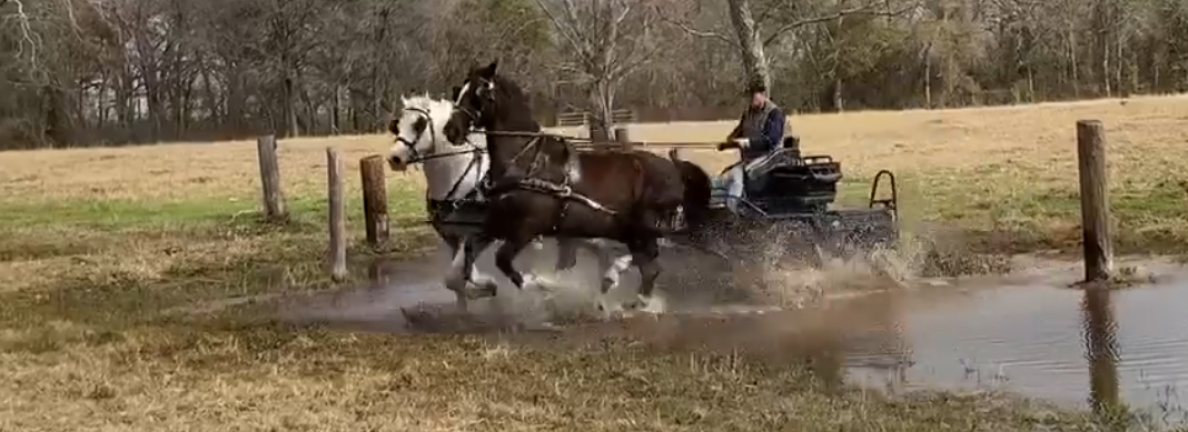
Why do we need brakes on our carriages? Imagine you’re out for a drive, and come to a downward incline. You shorten your reins and start down the hill. But what is stopping your carriage from pushing the horses down the hill?
Traditionally, the horse provides the primary braking action for the carriage. For example, many carriages in the 18th or 19th centuries had no brakes at all and relied fully on the horses to slow or stop the carriage even when moving downhill, by means of full collars and/or breeching.
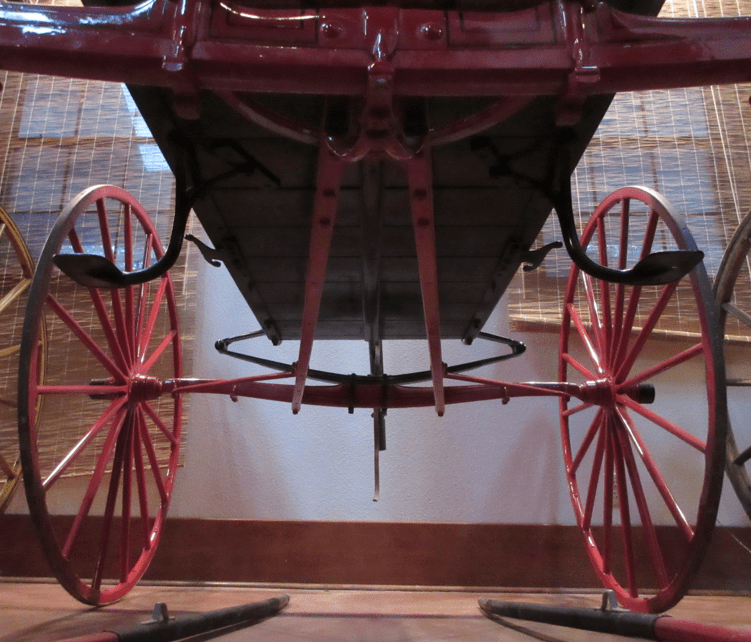
For steep hills, where the horses might be unable to hold back the full weight of a loaded carriage, one wheel might be chained to create drag, or a drag shoe might be used. Why only one wheel? Because having both rear wheels locked can allow the carriage to fishtail, which may cause an accident.
The drag shoe is a simple auxiliary braking system that was typically used on gravel roads with steep inclines. This is where they are most efficient. They are less efficient on modern tarmac, and the shoe wears out exponentially faster. Learn more about drag shoes in our article, Drag Shoes: The Nitty Gritty.
As roads improved, carriages traveled at higher speeds and it became desirable to have a built-in braking system to assist the horses in slowing or stopping a carriage, especially on steep inclines.
Modern carriages of the late 20th century onward usually are manufactured with disc brakes, but we can see a variety of braking systems that were used on antique and traditional carriages before the present day.
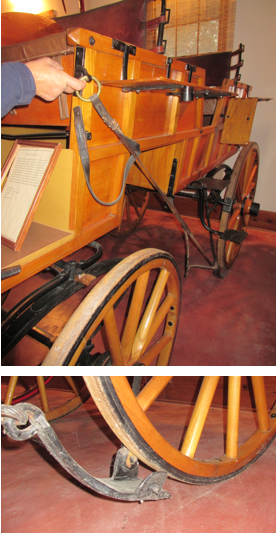
The drag shoe continued in use on some carriages well into the 19th century. It was cheap and simple, but it required a groom to apply it or remove it. The one on this Austrian hunting wagon improves on the concept through the addition of a leather strap and metal lever that enabled the box seat passenger to apply or remove the drag shoe without the help of a groom.
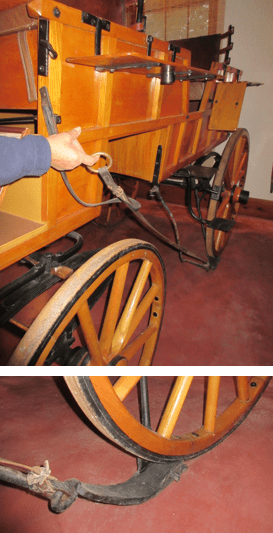
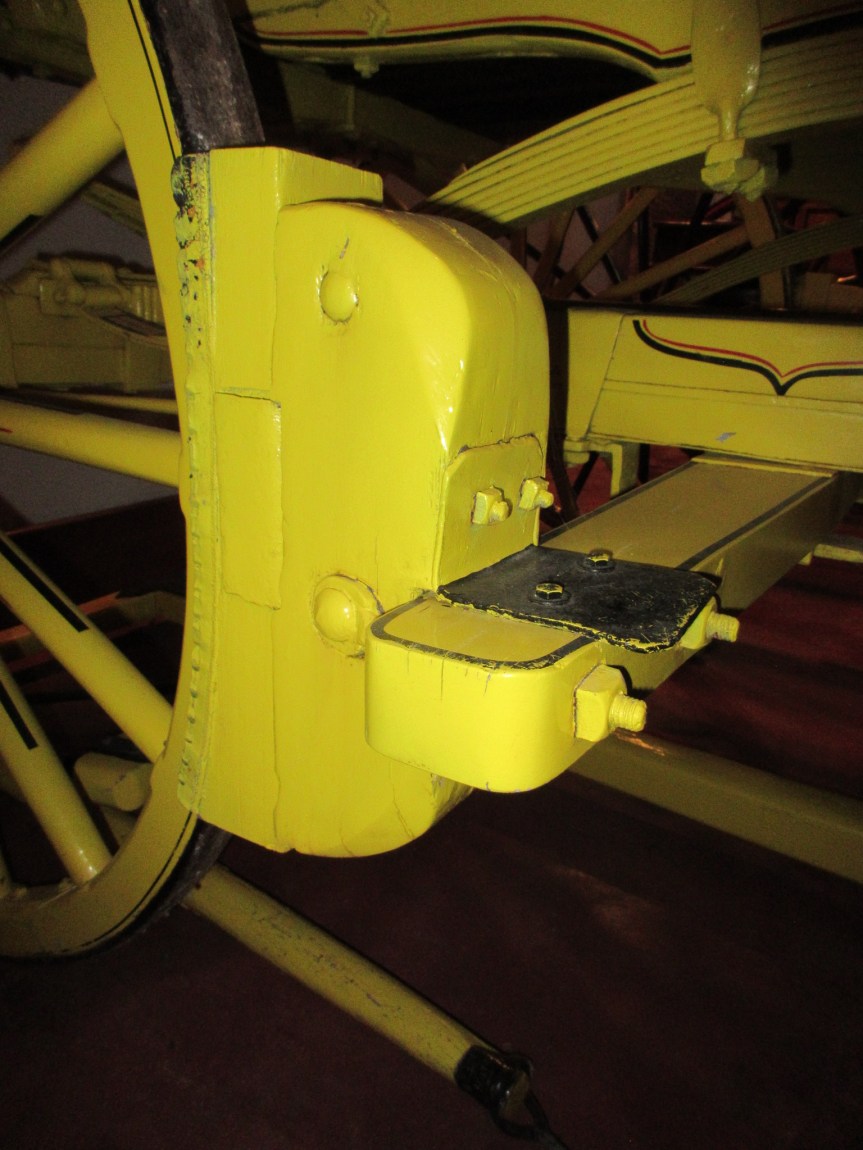
More advanced brake systems consisted of some mechanism that applied braking force to the tires or hubs, and some control mechanism near the driver’s box seat. Block brakes were among the most simple types, typically consisting of a block of wood that slowed the rear wheels through direct friction. These were often found on vehicles with iron tires.
Band brakes consisted of a band of friction material around the hub. As the vehicle moved forward, the band would tighten further. The disadvantage of a band brake was that if the carriage rolled backward, it would unwind the brake.
Drum brakes, which appeared in the 20th century, were traditionally located on the rear wheels. More recent vehicles with drum brakes have them on both front and rear wheels, as the addition of front brakes helps to prevent the possibility of fishtailing and keep the carriage moving in a straight line.
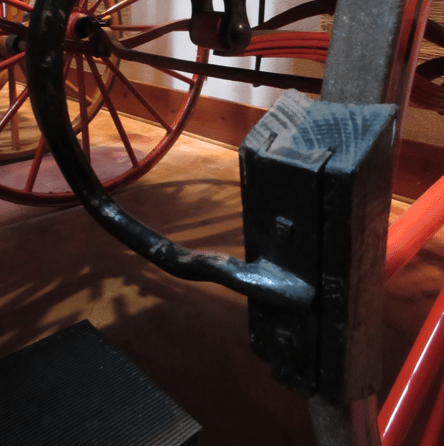
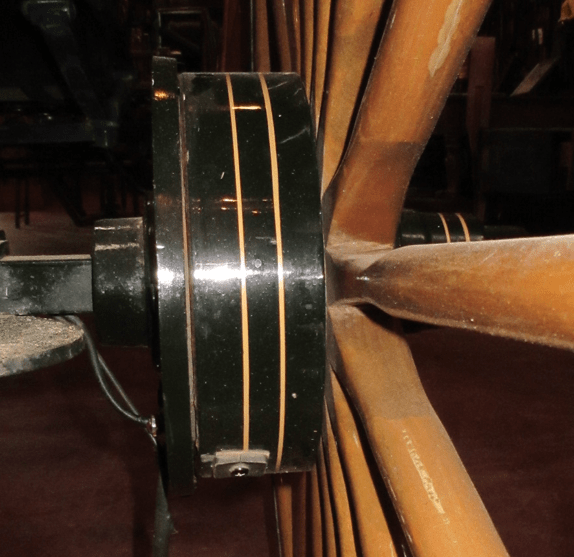
The driver’s control mechanisms can be divided generally into two types: levers, and wheels (or cranks). The wheel was more common in Europe and the lever was more common in Britain and America.
The lever can be further divided into push or pull levers, and hand-operated or foot-operated levers. The advantage of a push-style hand lever is that it typically requires less effort to use, and the advantage of the foot lever is that it allows the driver to keep both hands on the reins and whip. One disadvantage of the lever is that it can fail to lock in place as intended, and bounce back.
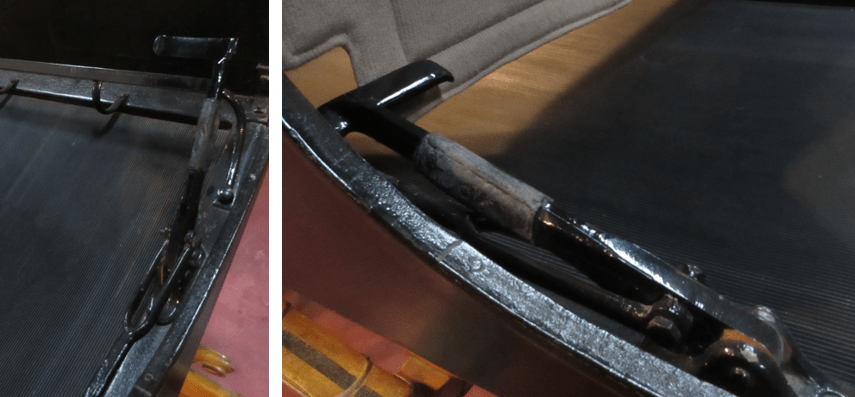
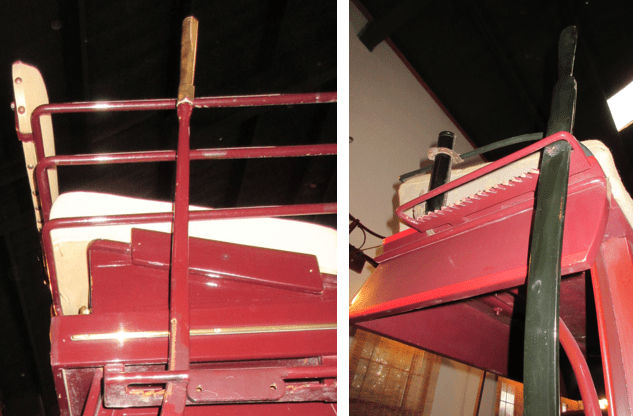
The wheel or crank mechanisms require less strength to use, thanks to the mechanical advantage conferred by the gears. They are therefore easier to use for women, junior drivers, or anyone of smaller stature. A wheel can also allow the driver to be much more precise in how they apply the brake, and avoids the potential problem of the brake failing to lock and bouncing back.
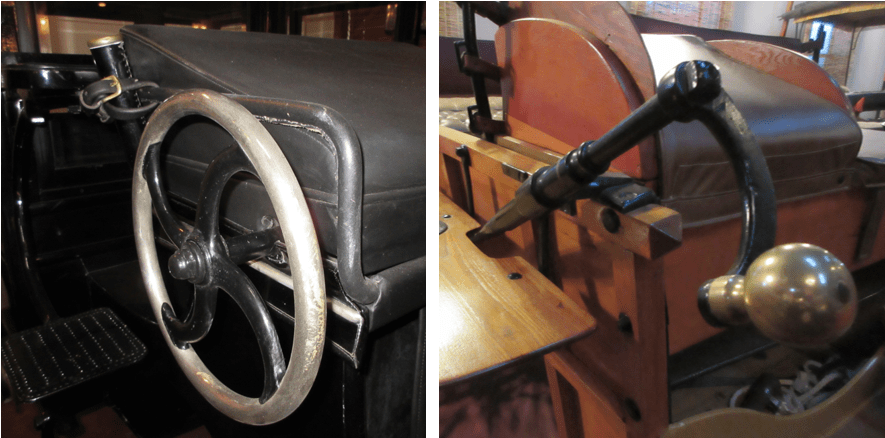
Brake wheels and levers can also be set as parking brakes. In my experience, I found the traditional wheels and levers to be a bit more intuitive to use than the mechanisms on modern carriages, which include foot pedals as well as a lever. On a modern carriage, the driver will step on the brakes and then use the lever to lock them.
Now for a little whimsy: could this be the origin of the term “slow your roll?” Readers, what do you think?
 Ranch Ride Carriage Drive LLC