
The Dictionary of Horse-Drawn Vehicles by D. J. M. Smith states: “Drag Shoe. Skid pan or wedge used as a crude brake, when jammed under a rear wheel. Also known as a Drag Bat (this was apparently a country name for a Drag Shoe).”
If you will be driving in hilly terrain, and you find that the gradient of the hill is too steep for your foot brake or hand brake to be effective, the drag shoe is your friend. Here, we will learn what it is and how it is used.
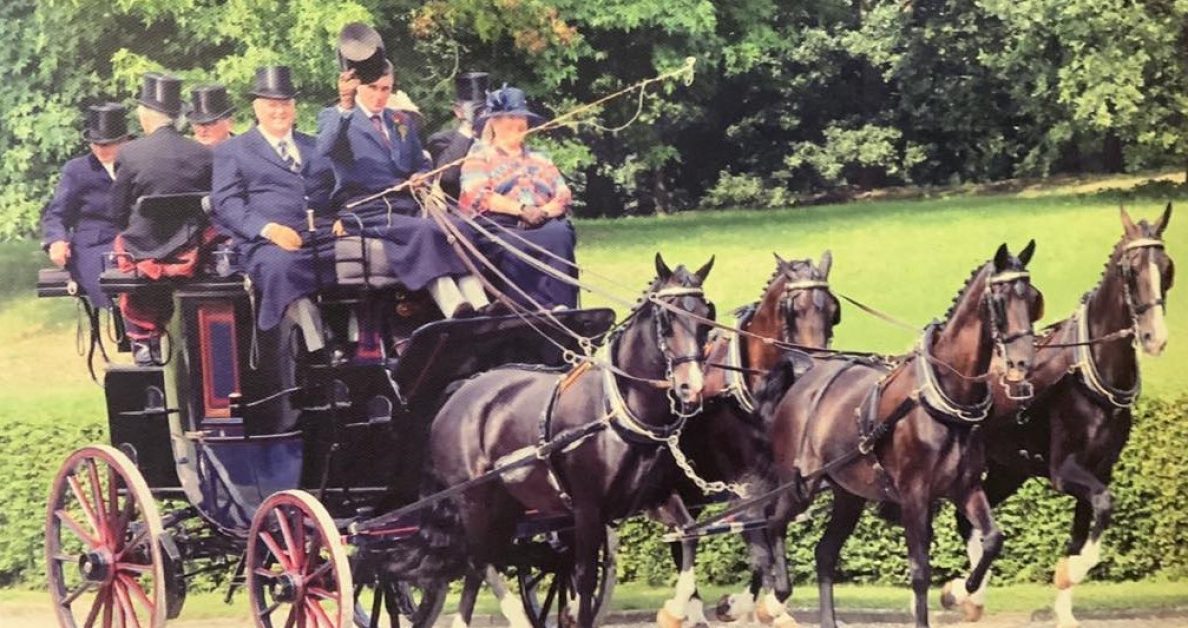
The drag shoe is carried by most European and American coaches and is used as an external brake for going downhill when the gradient of the hill is too steep for the coach’s brake alone to slow the motion of the wheels.
The drag shoe is constructed of steel and looks very much like a slipper. Its base should be about six inches wide. A wide shoe is preferred as it causes much less damage to the road surface than a narrow shoe (one which is just wider than the wheel of the coach itself). The front edge of the drag shoe curves upward so that the shoe rides over most obstacles in its path.
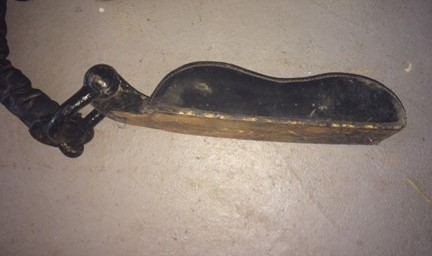
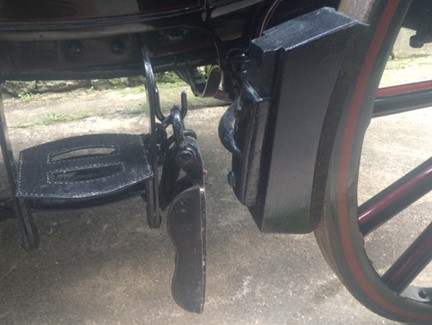
The drag shoe is attached to the coach via a hook and chain that is hooked to a bracket on the front axle. The hook and chain should be long enough, when unhooked, to reach the middle of the back wheel when applied.
On many original coaches, there is a second chain with a large leather-covered hook. Its use is explained in Fairman Rogers’ Manual of Coaching, where he suggests the following as an addition to your drag shoe:
“A hook large enough to hook around the rim of the wheel and covered with leather, is sometimes attached by another chain to the same part of the axle. This is hooked on the rim of the wheel below where the brake touches it, and holds the wheel in case the skid comes off. Instead of having a large hook, the chain itself is sometimes made long enough to go around the rim, that part of it which touches the rim being covered with leather. At the end of the leather-covered part is a small hook which goes into one of the links of the chain.”
As we will see, it is important that when in use, the shoe should run parallel to and next to the curb. This is why the drag shoe hangs on a bracket attached to the brake block on the passenger side of coaches in Britain, but it should be attached on the driver’s side in America and the rest of Europe, where one drives on the right side of the road.
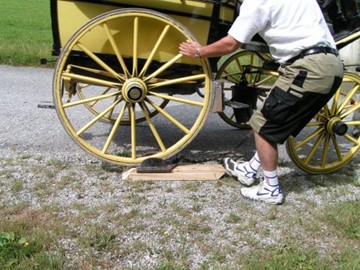
Before descending a steep hill, the shoe is unhooked from its bracket and placed in front of the wheel of the stationary coach. One member of liveried staff should stand with the horses whilst the other applies the shoe. On a Road Coach, fitting a drag shoe would be the guard’s job, but on a Park Drag it would be the job of the second coachman.
We typically only place the shoe under one back wheel, as this allows the coach to pull straight. If we skidded both back wheels the coach could fishtail and possibly turn over. When the drag shoe is applied to the curb side, back wheel of a coach, it allows the coach to be pulled against the camber of the road, keeping it straight. However, if one were to apply the shoe to the other back wheel instead, the coach could be pulled in the same direction as the camber of the road, making it very difficult to keep the vehicle straight.
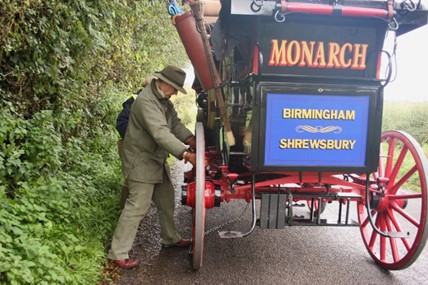
When the driver is given a clear signal to remove the handbrake and move off, if the shoe has been properly placed in the correct position, the wheel rolls into the shoe and is locked in place. The grooms then mount the carriage, with one remaining on the step to ensure that the drag shoe remains in position. Because of the upward curve of the front of the shoe, it should glide over most obstacles; however, it is advisable to have someone stand on the rear step to keep an eye on the shoe in case an obstacle is hit that causes the shoe to jump off the wheel. As the coach descends the hill, the driver should also use his hand or foot brake to help with the braking but must be careful not to lock the other back wheel.

The drag shoe is a very effective brake, but it must be remembered that it was primarily designed for use on gravel roads, not our modern tarmac roads. The braking efficiency of the drag shoe can be much enhanced if the driver can keep close to the edge of the road, enabling him to take advantage of any loose gravel typically found on the road’s edge. This is especially helpful should the road become wet.
Andreas Nemitz, proprietor of Coaching in Bavaria, developed a unique method to improve the traditional drag shoe to accommodate modern roads. He did this by modifying the shoe to take a pine-faced abrasion board, held on with a dovetail to make for easy fitting and removal. Pine was used as it has the best co-efficient to drag and is fairly cheap and readily available. The top of the board that goes into the dove tail is made of a harder wood (such as beech or ash). This enables the pine section to be replaced when it gets worn. As the coach descends the hill, the board actually smolders and burns, so it is important that the groom monitors how much board is remaining. Just as with the metal shoes, if the road surface is wet, more friction can be gained if the groom walks just in front of the coach and spreads coarse sand or fine grit as it moves along.

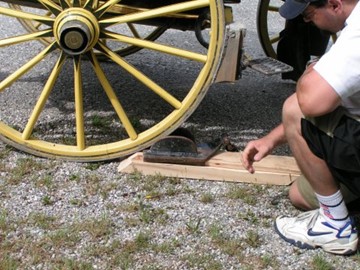
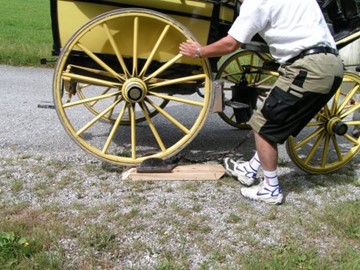
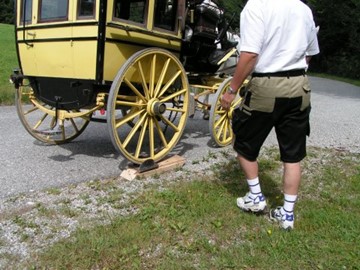
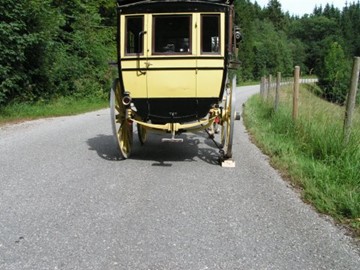
When removing the drag shoe, one should be at the bottom of the hill on a flat surface or, if possible, on a slight upward incline. This makes it easier to reverse the horses to get the wheel of the coach off the drag shoe. One also must handle the shoe with care to avoid getting burned; after a long downhill descent, a metal drag shoe can become quite hot. On one occasion, I saw a colleague successfully fry an egg on the shoe at the bottom of a hill!
Fun fact: it is a generally accepted rule of thumb that a loaded coach should never attempt a hill where the gradient exceeds 16%.


One thought on “Drag Shoes: The Nitty Gritty”