
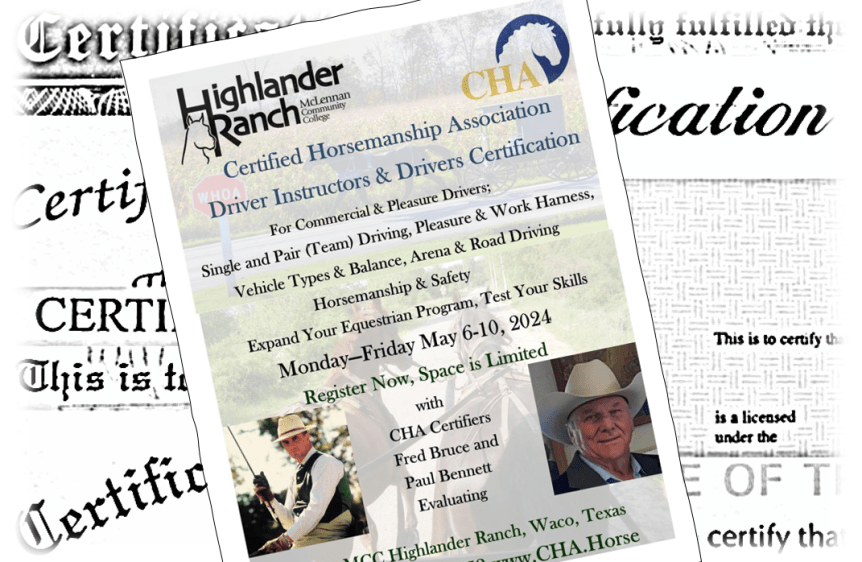
Note from Ranch Ride Carriage Drive: this week, we are on the road to McLennan Community College’s beautiful Highlander Ranch in Waco, Texas to assist the Certified Horsemanship Association with a five-day certification clinic for Driver Instructors and Drivers! Paul strongly advocates nationally-recognized certifications for carriage drivers, especially if you are driving commercially. Why are certifications so important? Have a look at the article below. We have published it before, but it’s worth a read if you missed it previously!
If you’re signing up for riding lessons, hiring a horse trainer, or booking a carriage driver for your wedding, how do you really know that you’re getting a professional who knows what they are doing? Or, if you’re a professional who offers equine services, how can you assure the public that you are safe, ethical, and capable? Who vouches for you?
Spoiler alert: consider certifications.
When I started working with horses over 30 years ago, you received training and built your reputation under the professionals you worked for. Training was part of the job and in some cases, you could even be expected to work for free in exchange for training. Like most other people of my age, it was normal to work long hours for low wages for “the love of the job!” You started at the bottom cleaning stalls, and heaven forbid you forgot to make sure the manure pile was neat and tidy, along with anything else you were told to do. Most people worked for and studied under an experienced head coachman, stud groom, trainer, etc., who’d spent years working their way to the top in that role. Career paths were not well defined, so you might spend 10+ years working towards moving up! This would include not only advanced horse care, but a variety of other skills like HR, business management, negotiator, coach, plus a myriad of other requirements as the need arose.
As you can imagine, there was a lot of variation from one establishment to another. For good or ill, who you worked for and trained under would have a huge impact on your knowledge, your professional practices, and your reputation. For many, not much has changed.
There is another side to this coin: currently it’s too easy to hang up your sign as an “expert” without any real training or knowledge. In many cases, the public really doesn’t appreciate how much potential danger there is, or what could happen if things go wrong.
Thirty years ago, certifications were just beginning to make the industry more professional and standardized. Today, many national and international organizations offer a wealth of certifications in any number of equestrian disciplines or areas of horse care.
The certification process can be scary! You put yourself out there to be judged, which takes courage for most of us. There are fees and you may have travel expenses. Most certifications require a combination of written, practical, and oral tests, oftentimes in a place you’re not familiar with, as you are dealing with nerves, expectations, hopes and dreams. It can certainly be crushing when you come up short. However, it should be a learning experience which allows you to grow and learn, encouraging you to try a little harder, study some more, and come back to be successful.
So why should you go to all this effort? What’s in it for you?
In my opinion, the greatest advantage of a certification is that it proves you’ve been independently and impartially assessed and met the standard criteria for the certifying organization. Some organizations provide training as well as testing, so you can improve your skills at the same time you’re working to meet a recognized standard.
In choosing one certification over another, you’ve got to weigh what’s involved, whether it helps you gain more skill and experience in your role within an organization, or whether it might give you a leg up to a higher level.
Safety is almost always a top priority for any organization. Certifications show that you are able to minimize risks to the people in your charge. As we move forward, I think that insurance companies will eventually require professionals to be certified as a way of mitigating risk to both themselves and the insurance company.
Certifications also help to set professional standards and maintain the enormous number of equestrian traditions for future generations, bringing a higher level of care to our equine partners who bring us along on our incredible journeys in the horse world.
So, get yourself certified! I think you will find that the process improves your professional reputation and brings new skills in horsemanship.
 Ranch Ride Carriage Drive LLC