
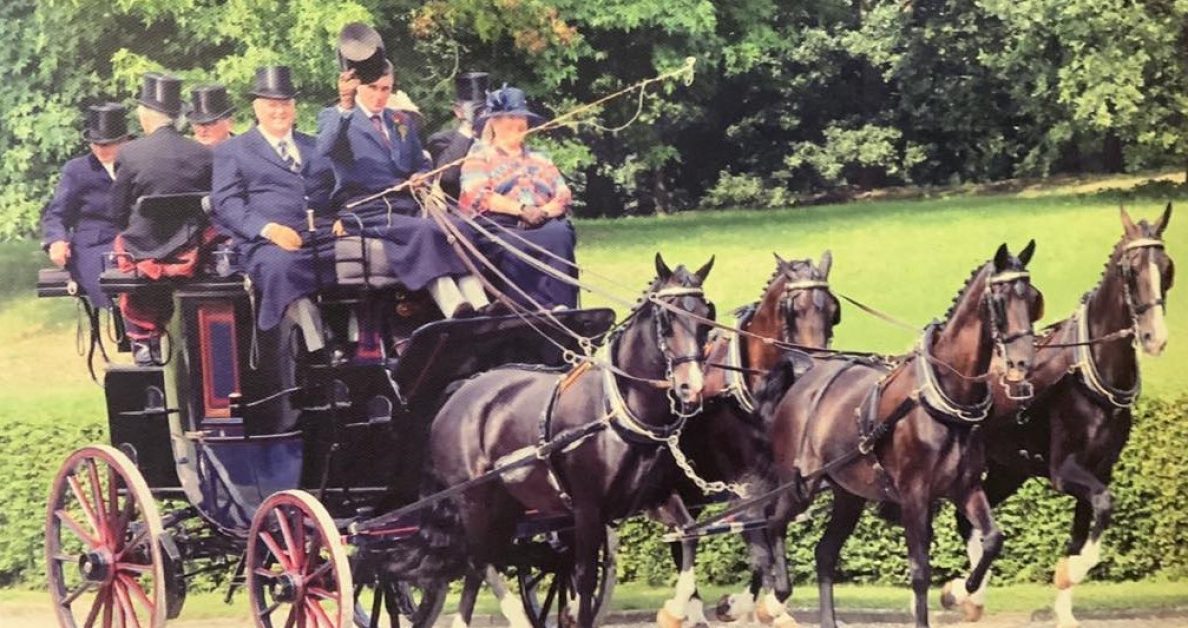
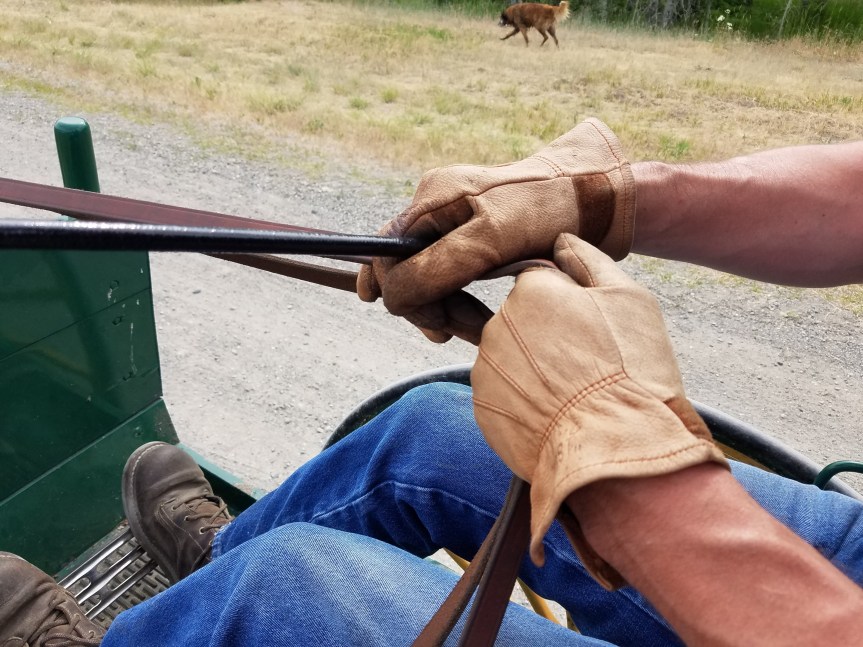
Are you a pairs driver? If so, and especially if you drive different pairs of horses over time, you will undoubtedly run into the situation where one horse is larger than the other, or perhaps has a longer body or neck. Maybe one horse is lazier than the other, or has a longer or shorter stride than the other. So how do we address this?
Over the past thirty-odd years, I have worked with many different drivers and their horses. Too often, drivers will look to correct these problems with improper adjustments to harness. For example, take the common problem of a pair with one lazy horse and one willing horse. If we want our horses to pull the weight of the carriage equally, the traces should be adjusted so that the horses’ collars are even with each other. Too often, I have seen drivers who attempt to correct a lazy horse by shortening its traces, but this is incorrect. The consequence is that the lazy horse is now constantly in draft, being punished with no relief, and the driver has no way to reward the horse for working hard.
All right then, how should we address this?
The real answer is to understand and use proper adjustment and handling of the reins. Correct adjustments will help your pair function together smoothly and evenly. Incorrect adjustments and handling can result in one horse doing more work and getting hard in the mouth, poor horse behaviors, or can even contribute to accidents.
To fully understand the principles of rein adjustments, you must keep in mind the size of your horses and the length of their necks. Your objective is to allow both horses to stretch their necks freely so that they can move forward and have uniformity and balance between them. Adjustments, in the form of lengthening or shortening reins, are made to encourage the horses to respond evenly to rein aids, despite differences in their size or way of going.
So what exactly are these rein adjustments?
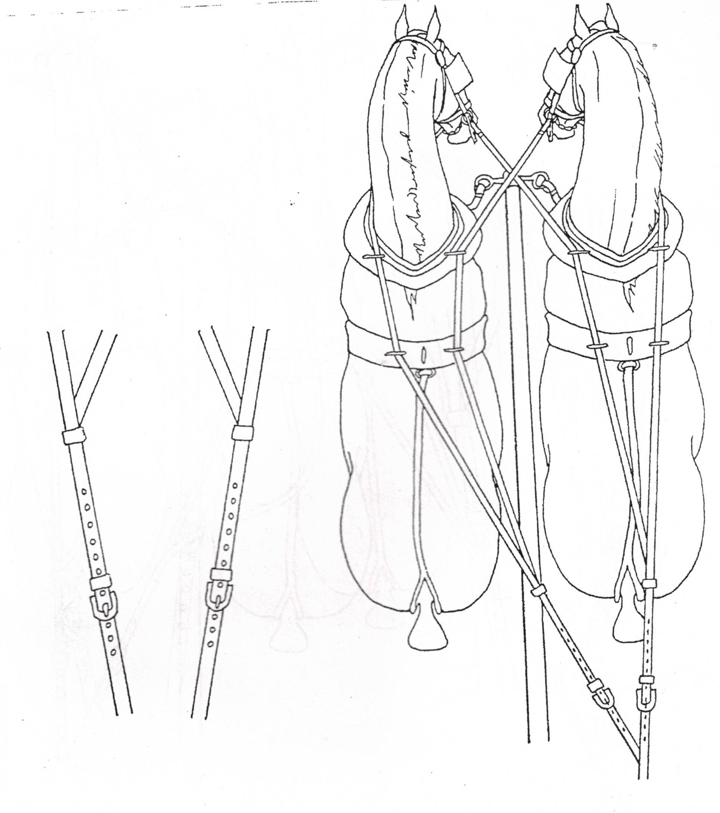
Notice that the coupling rein attaches to the draft rein by means of a buckle, and the draft rein has a series of holes so you can adjust the placement of the coupling rein. The number and placement of the holes will vary according to the maker of your reins. Moving the buckle back (toward the driver) will shorten the rein. Moving the buckle forward (away from the driver) will lengthen it.
The illustrations in this post feature reins specific to Benno von Achenbach’s system of driving, which can help us to understand the principles of rein adjustments in general. Just as with other reins, adjustments are made by moving the buckle of the coupling rein to different holes on the draft rein; but Achenbach’s reins have eleven holes at standard positions on the reins. This allows for more adjustability than most other reins, and it makes it easy for us to see the principles of proper rein adjustment in action.
Adjustments in the Achenbach system are expressed as the number of open holes between the buckle and the driver’s hand, which add up to a specific number as shown in the chart below. When lengthening the rein, there will be more open holes; when shortening the rein, there will be fewer open holes between the buckle and the driver’s hand. Holes beyond the buckle have no effect. This should also be true for pairs reins made to other standards.
Achenbach recommends starting with standard rein settings for different sizes of horses. Taller or larger horses will need longer reins; we can see that there are more open holes recommended, meaning, a longer rein. The standard Achenbach settings below are only a start point and are set to equal lengths assuming that you have two equally sized horses working together equally. Keep in mind, the start point for your horses on your non-Achenbach reins will be different!
15 hands 4 + 4 = 8
16 hands 5 + 5 = 10
16.2 hands 6 + 6 = 12
17 hands 7 + 7 = 14
An important point in the Achenbach system is that the sum of the open holes should not change for your pair of horses. If you start with a setting of 4 + 4, and then lengthen one horse’s rein from 4 holes to 5, you must also shorten the other horse’s rein the same amount, from 4 holes to 3, so both reins will still equal 8, e.g., 5 + 3 = 8. Even if you do not have Achenbach reins, the principle applies: if you shorten one horse’s rein, you should lengthen the other horse’s rein by an equal amount to achieve balance.
Once we have the overall length set for the size of our horses, the horses’ heads and necks should be basically straight. If their heads consistently turn inward toward each other, the coupling rein is too short. If their heads consistently turn outward away from each other, the coupling rein is too long.
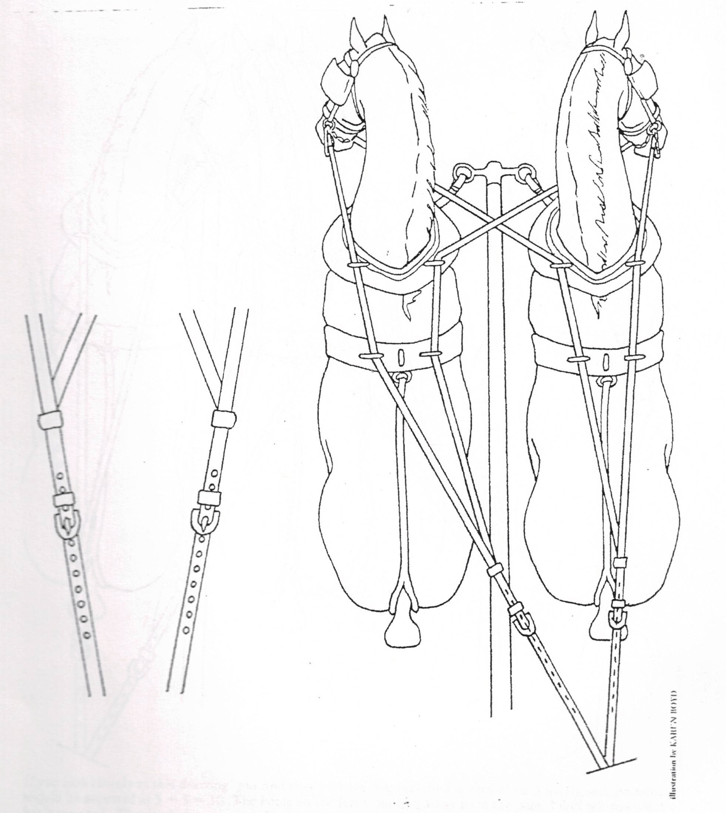
In an ideal world, our horses would be perfectly matched, and our reins would be set exactly the same on each side. But let’s say you have a lazy horse and a willing horse. By shortening the rein of the willing horse and lengthening the rein of the lazy horse an equal amount, you allow the lazy horse to come into draft before the willing horse, thus making the adjustment for their differing temperaments and sharing the work evenly between the horses.
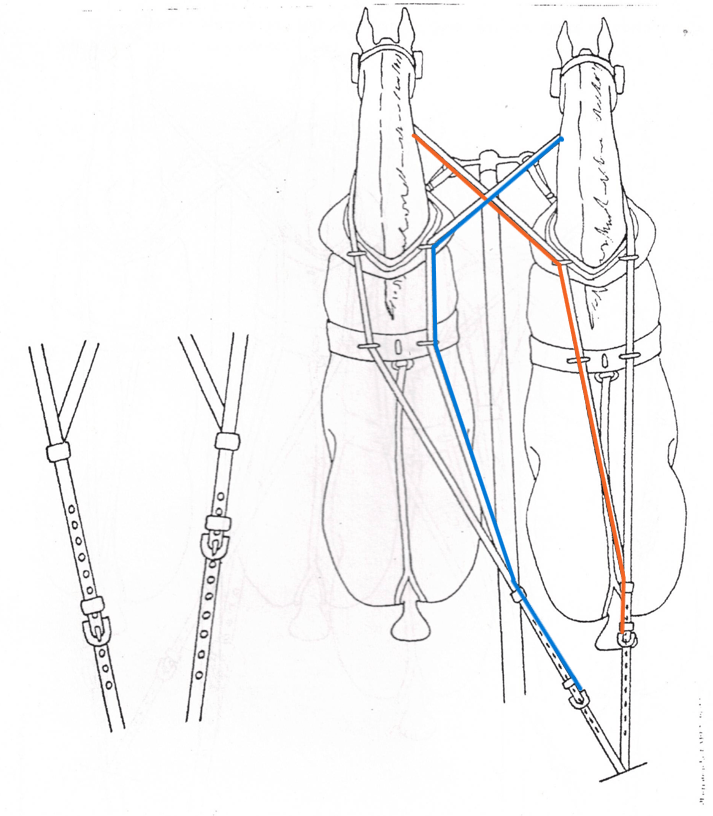
Drivers must be able to study how the horses are going, must know how and why to adjust the reins, and then make helpful adjustments as promptly as they are required. Before getting on the box seat, check how the reins are set, especially if you drove different horses last. While you are driving, you should be constantly assessing how your horses are going. Your hands can feel through the reins whether one horse is pulling, or if they are light. Can they both move forward easily and comfortably, or is one horse doing all the work? If needed, you should immediately adjust the reins to try and balance the workload as evenly as possible. Some pairs begin the drive with one rein adjustment setting, but once the horses have warmed up and are going forward, they might require the rein setting to be altered.
Since learning about the Achenbach system from Andreas Nemitz, I have preferred to use Achenbach reins because they are made to a specific standard, have a wider range of adjustments than most other reins, and can be adjusted easily for different purposes and for various horses. But whether you own Achenbach reins or not, these general principles apply.
Next time you have a driving lesson, watch and feel how your horses are going. If you have an ongoing issue with one of your horses and haven’t tried adjusting the reins yet, work with your instructor to adjust the reins for your particular situation. Safety first, and enjoy your drive!
 Ranch Ride Carriage Drive LLC
One thought on “The Importance of Proper Rein Adjustments”