
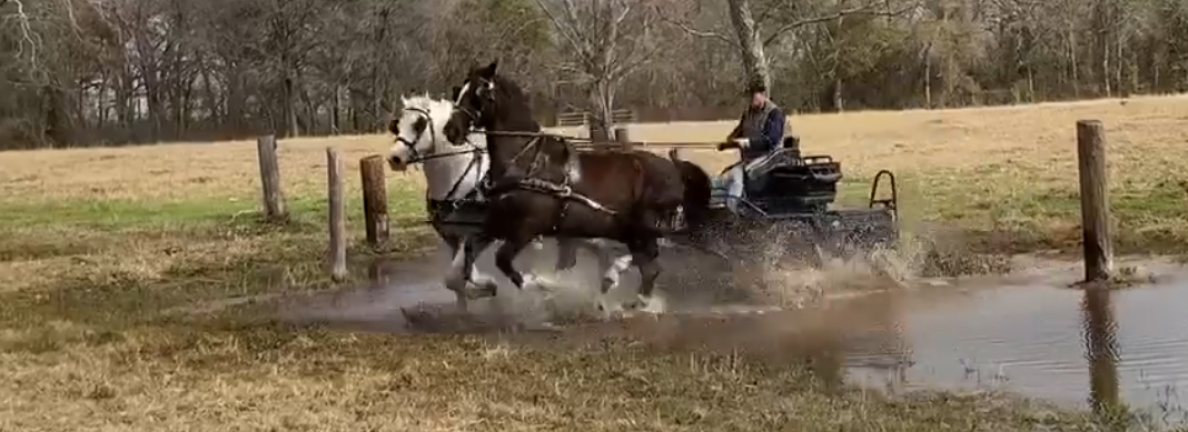

When we drive out for fun, are we still practicing our dressage moves? The answer is, we should be! Every drive should be fun, but also allows us to improve our skills and the suppleness of our equine partner.
Anytime we come to a curve in the road or track is a chance for us to practice bending our horses. Having them bend enables us to drive accurately and safely, whether it be through a course of cones, or around real-world obstacles such as parked cars.
As we enter the turn, we should balance the horse and ask him to slow his pace ever so slightly. The most forgotten thing about making a turn is the half halt. If we make a half halt just at the moment that the horse’s nose enters the turn, then we get the horse’s attention just before giving the command to turn. This prepares the horse to bend smoothly around the turn. If we don’t use a half halt, and just pull the rein, the horse will be unprepared. The usual result is that the horse will probably look in that direction, but his shoulder will slightly be travelling in the opposite direction, falling out of the turn.
As the horse bends in the direction of travel, he must be allowed to stretch on the outside of the turn to allow both shoulders to track along the arc of the curve. Remember the give and take on your reins. As you take one, you should be giving on the other. This is what actually allows the horse to bend around the curve.
The horse also must stay balanced as he travels around the curve. He should have his inside hock engaged and push from the hock to enable the bend. This is analogous to “inside leg, outside rein,” and is especially important with a pair. We need the outside horse to cover more ground than the inside horse, but the inside horse needs to stay in draft and pull through the turn to maintain the curve and the bend correctly. We also must be vigilant that the outside horse does not push the inside horse toward the apex of the curve. You don’t want your wheels hitting the curb!
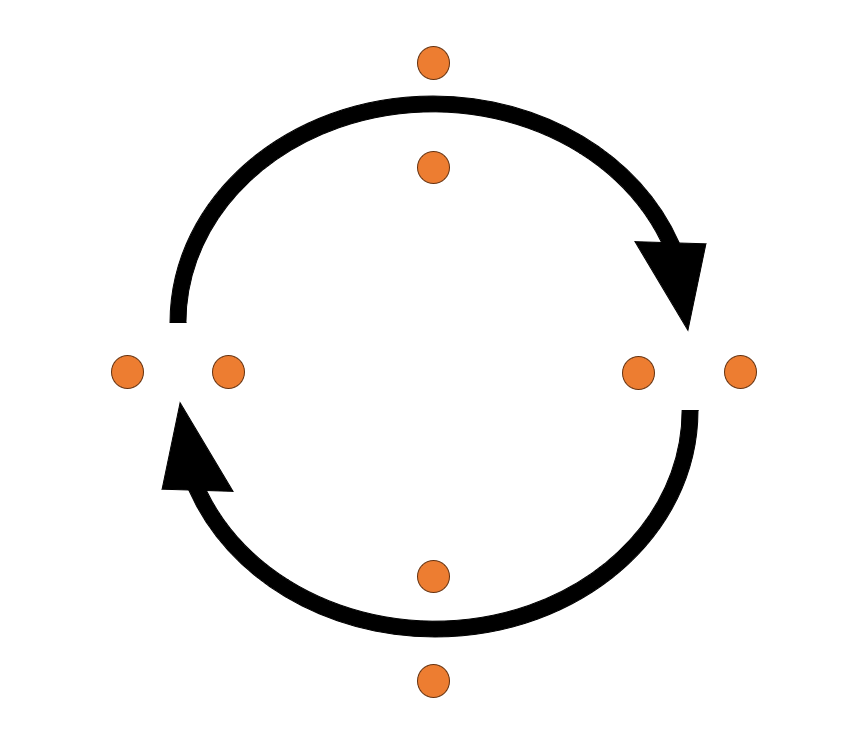
In planning your turn, it may help to imagine a curve as a series of straight lines connecting the dots. A good exercise to improve your circles is to set out four pairs of cones as in the diagram here, and drive from one pair to the next. This will help you think about your circle in a more definitive way.
If we train consistently on every drive, then our horses will know what to expect when we get to our dressage test!
 Ranch Ride Carriage Drive LLC