

If you’re thinking that our cattle show some resemblance to the cattle of India, your eyes do not deceive you! Several different breeds of Indian cattle were imported to the southern United States as early as the mid-19th century. By 1926, roughly 300 cattle of Indian origin had been imported to the United States and were crossed with other existing breeds to form a quintessentially American breed that is world-renowned for its ability to thrive even in difficult environments.

Texas is home to the American Brahman Breeders Association (ABBA) which was founded nearly a century ago, in 1924. It was at their first meeting that the breed name was proposed and became official: American Brahman.
Cattle are typically very susceptible to heat stress. According to the USDA, heat stress can occur when the Temperature-Humidity Index (THI) is as low as the mid-70s Fahrenheit. For most cattle breeds, heat stress lowers fertility, milk production, and weight gain, and can even result in death of the animals. As the THI rises, so do the risks.
Brahmans are different. They can match other cattle breeds for cold-weather tolerance, but their heat tolerance is unmatched. They thrive even in temperatures above 105 degrees Fahrenheit. With ongoing climate change and much of the continental United States experiencing a drought since late 2020, this is becoming more important than ever.
Brahmans are also famously good mothers, reproducing and giving plenty of milk even when they are living on poor feed or in stressful environmental conditions. They are pest-resistant, long-lived, hardy, and have good stamina. They are also intelligent and if treated with kindness, they are docile and easily handled.
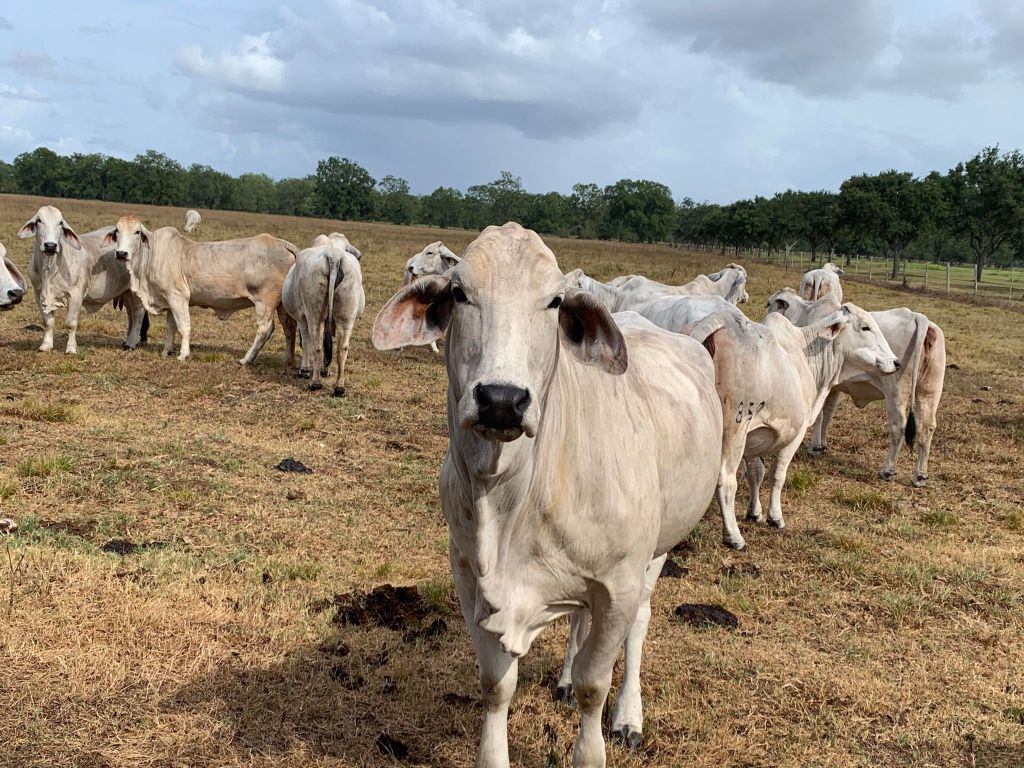
The Brahman is an excellent beef producer, and improves beef production in any herd where it is introduced. This trait owes much to the work of the Hudgins family, dating back to 1908 right here in the Wharton area of Texas. A key moment in the history of the American Brahman breed was Walter Hudgins’ purchase of a bull named Manso in 1933. Within a year, despite the Depression-era economy, Hudgins was selling Manso’s offspring for ten times the typical cost of a Brahman-type cow with calf. Manso was unusually heavy-set, large, fleshy, and docile for a Brahman bull of his time. He was also both prolific and prepotent, eventually producing 316 offspring that carried his influence and helped to create the modern American Brahman. According to J.D. Hudgins, Inc., “It has been estimated that over 75% of all cattle registered by the American Brahman Breeders Association carry Manso breeding.”
Crossing Brahman bulls onto cows of other breeds offers so many benefits and such remarkable hybrid vigor, that the Brahman is in demand worldwide to improve beef herds in any environment. As ABBA states, “they are an unparalleled success story.”
Here at Ranch Ride Carriage Drive, we enjoy the company of these amazing Brahmans!

 Ranch Ride Carriage Drive LLC